Research Blog Helen White
Creating science hypothesis' and statistical conclusions about the world!
RECENT POSTS
- Research project (Reaction Time vs Distance in Lunge Success)
- Do Sound Frequencies Have Effects on Mood?
- Does Engaging with Art Mindfully Reduce Daily Stress Compared to Idle Behavior? (Psychology and neuroscience)
ABOUT
A SLOHS sophomore interested in conducting scientific research along with statistical observational studies. In this webpage, you will follow me through my journey of research and data analysis to answer hypothesis' I have developed about the world, and how science can connect it all!
-
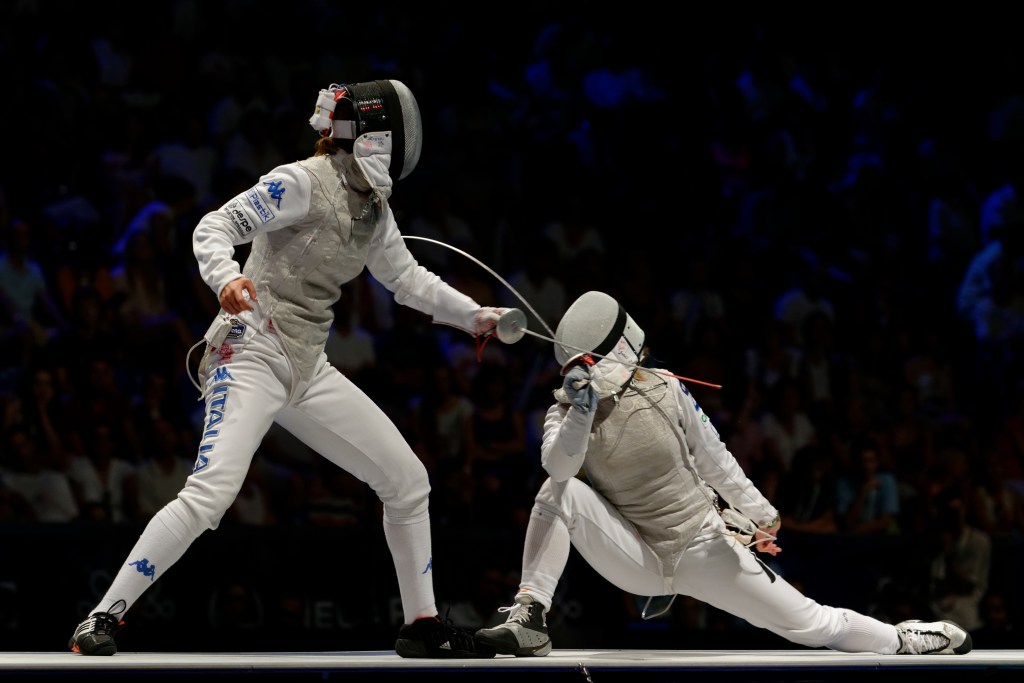
Reaction Time vs Lunge Success (Physics)
Have you ever wondered if the speed of your decision making in fencing was actually the reason your lunges weren't hitting? Fencing is a tempo sport, and timing is crucial. Lunges, depending on what style you use, are normally  2 to 4 seconds; but how many tempos are to many, or how do top fencers speed up their attacks whilst still keeping precision? I found this trouble when making my attacks in ranked tournaments, and observing top fencers complete a lunge, I wondered if their lunge success was directly associated with the reaction time of their opponent to complete a parry. In other words, if you complete a lunge faster you will land a hit on your opponent. But then this had me thinking about two or even three tempo lunges like a balestra or an advanced lunge.

I conducted a chi-squared test for Independence to prove my hypothesis. Below is the data collected for my observational study from a random sample of lunges performed at a local tournament.

                                                                 HIT                                  NOT HIT                                TOTAL
Lunge: 1 second
(no parries)10 12 22 Advanced Lunge: 2 seconds (no parries) 6 12 18 Balestra: 0<x<1 second (no parries) 14 5 19 Total: 30 29 59 CHI-SQUARED TEST FOR ASSOCIATION | STAT TEST C
Null Hypothesis: There is no association between lunge type and the success of making a hit.
Alternative Hypothesis: HO is false.
Large Counts: All expected counts found in Matrix B (11.2, 10.8, 9.2, 8.8, 9.6, 9.3) > 5
10%: 59n<590N assuming that there were approximately 590 lunges made at the eight hour tournament in women's foil.
Random: A random sample of 59 lunges at the local tournament.
(10-11.2) ²/11.2 + (12-10.8) ²/10.8 . . . = χ2= 6.430 p-value= 0.040 α = 0.05 df=2
Since the p-value(0.040) < α (0.05) , we reject HO. There is enough convincing evidence to say that there is an association between lunge type and the success of making a hit. Therefore, the faster you make a lunge (or the faster lunges in range), the higher success you will have in landing a hit on your opponent because they cannot react in time with the tempo.
Do Sound Frequencies Have Effects on Mood? (Biology)

February 2026 Having recently gotten back into meditation, finding my chi, I’ve appreciated the mindful silence in contemplation away from all the activities, tests, and other stressors in my life for a brief moment. However, after todays yoga session I found out something pretty fascinating from my teacher. Apparently, there is science in this after all! Different frequencies (Hz) elicit distinct changes in a persons mood. In channeling our inner Om, the voice of our mind is manifested in sound. To different people, certain frequencies can recall a memory, bring comfort, or Zen. The human mind can tap into certain frequencies when under stress. This is so powerful, as now science can prove that we can choose where we channel our energy.
But Ancient monks have known this for a while, haven’t they? Utilizing gongs and bowls in meditation, the lulling hum calming the mind and focusing our energy through ominous vibration. I think this is so fascinating, and I love to find ways to connect the things I practice to science—-or in this case, proving them.
Having some medical equipment from my time researching during the summer of 2025, I figured I would run a quick experiment to test the effects of meditation on my body and mind. I believe emotion and stress effect the brain, with it’s vast neurological web of censors controlling my entire body. My stress can be manifested in stiffness, blood pressure, and SpO2. Even though I am an overall healthy person who eats fruits, veggies, and takes multi-vitamins, there is one silent killer that is out for us all—–stress; but now we can control it! Hear me out, but I believe this is partly the reason monks and other interdisciplinary practitioners liver longer; they take a moment to cleans stress!
- I am going to be running a Matched-Pairs T test
- I want to find out what the mean difference between two related measurements are, and if they are statistically significant.
- I will be meditating for 20 minutes a day for 10 days and record my findings below
SPO2 before: SPO2 after: Blood pressure before: Blood pressure after: Monday 97 99 118/81 115/70 Tuesday 98 99 117/80 116/73 Wednesday 99 99 117/75 115/70 Thursday 99 100 119/85 116/78 Friday 99 100 118/80 114/67 Saterday 98 100 119/87 116/71 Sunday 97 99 118/83 115/70 Monday 98 100 117/86 116/67 Tuesday 98 99 118/84 115/69 Wednesday 97 99 118/79 114/60 Find test statistic t:
t= μdiff/(sdiff/√n) where μdiff = the difference of the means where sdiff= the standard deviation of the differences where n= the number of pairs (days)
μdiff= sum of all differences/n sdiff=√Σ(diff- μdiff)² /n-1 degrees of freedom = n-1
Blood pressure:
Systolic diff (top number) Diastolic diff (bottom number) -3 -11 -1 -7 -2 -5 -3 -7 -4 -13 -3 -16 -3 -13 -1 -19 -3 -15 -4 -19 SPO2:
Difference +2 +1 0 +1 +1 +2 +2 +2 +1 +2 μdiff=14/10=1.4 on average, SpO2 increased by 1.4% after meditation.
Does Engaging with Art Mindfully Reduce Daily Stress Compared to Idle Behavior? (Psychology and neuroscience)

March 2026 I’ve spent some of the most euphoric moments staring at an artwork, dissecting the story, fixated on aspects like the medium or sfumato. If you already couldn’t tell that I am an art history nerd, then that was certainly a mouthful!
Recently, I’ve found that art, the aspect of standing in a museum, away from all the chaos of the world, has brought be a great deal of peace. I cherish moments of content where I can escape the practice of overthinking and working, even if it is for a split second.
Art doesn’t have to be that thing for you, but I feel that the practice of distraction, focus, and mindfulness is a great way to shift gears in our brains after an exhausting day of school.
Oftentimes, we don’t give ourselves that beat of change. We are so conditioned to moving from one class to the other, that when we are at home, after we have done sports or extracurriculars, we turn our “brain off”, to rest and most likely scroll. Scrolling is the worst thing you could do after a long day at school. While your brain is being funneled with media, it is still processing and recovering from the day like your body.
I am of course at fault to spiral into this behavior too, but I am developing a technique that can be utilized to strengthen mind focusing and recovery to improve a relaxed well-being.
My hypothesis is that focusing the mind on something else like drawing, observing, or taking in something in the present moment can be mindful to help decrease stress and brain noise; when we keep engaging the brain, it adds to the noise, and can effectively lead to a disturbed sleep schedule.
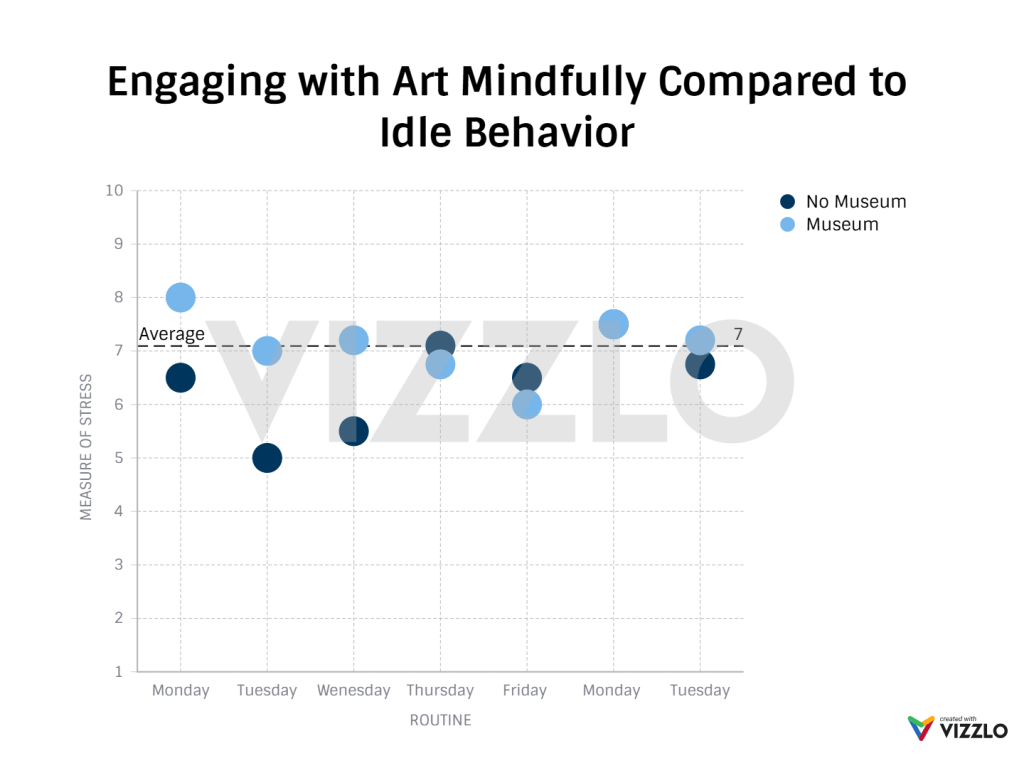
To find this out, I walked to the local art museum downtown everyday after school for a week, and spent 15 minuets drawing or looking at a painting for a good 5 minuets each, letting my brain wander off from the busy day at school while still being productive and critical.
Then I spent a week without going to the art museum, coming strait home and doing my usual tasks (scrolling, watching TV with my dogs, homework).
- INDEPENDENT VARIABLE (condition)
- Art mindfulness
- Normal Routine (no museum)
- DEPENDENT VARIABLE (measure of stress)
- Stress rating at the end of the day
- Time it takes to relax
- Number of intrusive thoughts (high/low)
- Sleep quality score
PURPOUS: Mindfulness through artistic observation may prove to be affective over cortisol and cognitive overloads by redirecting previous stressors from the day to start fresh.
 Research Blog Helen White